Charlotte Rental Market Report for Property Owners
Charlotte rents are flat, and concessions are doing the talking
Charlotte rents have barely moved in 2026. Zillow's typical asking rent for the metro was $1,735 in September 2026, up 1.4% from a year earlier and about 0.5% above where it stood six months before. Apartment List, which tracks new leases inside city limits, shows a 2.7% drop over the same year.
For property owners, the headline number hides the real story. About two in three Charlotte listings now come with a move-in deal, the second highest share of any large U.S. metro. Pricing a home correctly, and knowing which areas still hold value, matters more this year than at any time since 2020.
If your rental has been listed for more than two or three weeks without a signed lease, you are not alone, and the market data below explains why. F.I.R.M. tracks these numbers every month so our owners price and market their homes for the market we have now, not the one we had last year.
Is your rental sitting? Five likely reasons
In today's Charlotte market, a home that sits usually has one of these problems, and each one is
fixable.
• The price is anchored to last year. Asking rents are flat, and new apartments nearby are
discounting. A home priced 5% over comparable listings gets skipped in search results.
• No move-in incentive. About two in three Charlotte listings offer a deal. A home with
none looks expensive even when the base rent is fair.
• Weak photos or listing copy. Renters shortlist from photos. Dark, crooked or
phone-quality images cost showings.
• Slow response to inquiries. Renters with many choices sign with whoever answers first.
Leads that wait a day are usually gone.
• Limited showing availability. Homes that can only be seen on weekends lose renters to
buildings that offer tours seven days a week.
What a vacant month really costs
At Charlotte's typical rent of $1,735 a month, every vacant week costs about $400. One extra month empty costs the same as cutting the rent by $145 a month for a full year. Pricing to the market and leasing fast almost always comes out ahead. See What a Vacant Rental Really Costs for examples at every rent level.
This report is refreshed every month. Check the Last updated date at the top.
Rent trends: last 6 months vs last 12 months
Over 12 months Charlotte rents rose 1.4%; over the last six months they rose only about 0.5%, and since the July peak they have slipped 1.2%.
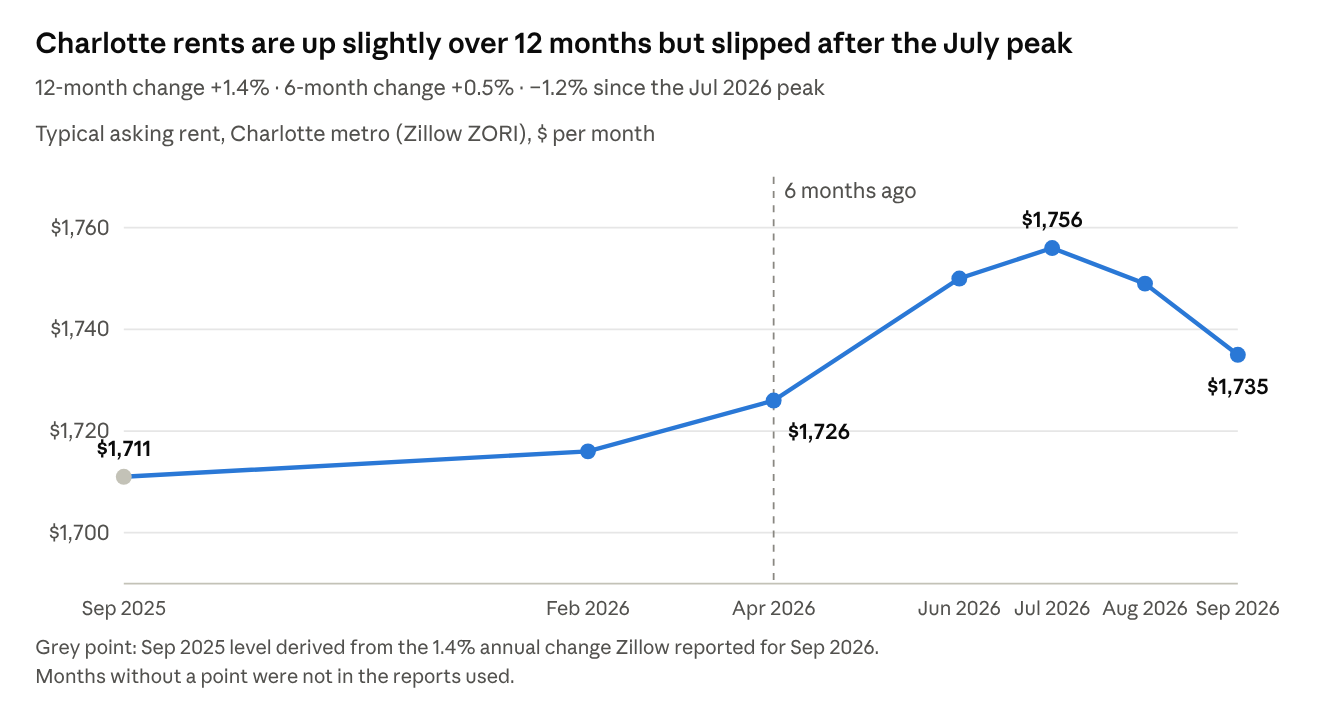
Zillow Research monthly rent reports, Feb–Sep 2026; Sep 2025 derived from reported annual change
The summer bump is normal leasing season, but this year it faded fast. The data providers also disagree on direction:
| Source | What it measures | Latest | 12-month change |
|---|---|---|---|
| Zillow ZORI | Typical asking rent, rent types and Metro | $1,735 (Sep 2026) | +1.4% |
| Apartment List | Median new-lease apartment rent, city | $1,381 (Sep 2026) | −2.7% |
| RealPage | Apartment rents, metro | Q3 2026 | about −2% to −3% |
The gap is mostly about what is counted. Zillow includes single-family homes and townhomes; Apartment List and RealPage track apartments, where new buildings are cutting prices hardest. Owners of single-family homes should read Zillow's flat trend as the closer comparison, and expect apartment concessions to pull renters' expectations down.
Why rents stalled: a wave of new apartments
Charlotte is working through one of the largest apartment building booms in the country. Roughly 13,000 units were delivered in the 12 months to Q1 2026, with about 18,000 more under construction at the time (Matthews, Q1 2026).
• Concessions are at record levels. 66.6% of Charlotte listings on Zillow offered a deal in
April 2026, second only to Denver (Zillow, April 2026). Matthews counts more than half
of all apartment properties offering concessions, the highest on record.
• Vacancy depends on who you ask. Matthews puts apartment vacancy at 6.2% in Q1
2026; TD Economics cites 12.5% (TD Economics). Either way, renters have more
choices than they did two years ago.
• Relief is coming. New starts fell 42% to 3,785 units, and Northmarq expects 2026 completions to run 23% below 2025 (Northmarq, Q1 2026). Fewer new buildings means less pressure on rents in 2027.
Single-family rentals are not immune. Rental Beast reports Charlotte single-family rents at about $1,600 in Q2 2026, down 3.0% year over year (Rental Beast, Q2 2026). Homes priced above the market are sitting longer, and every vacant month costs an owner roughly 8% of a year's rent.
Where rents are heading across the Charlotte area
South End, Dilworth and Uptown still lead the area at $2,070 to $2,172 a month, but they compete head-on with new luxury buildings and are giving ground: Uptown is down 1.3% and Ballantyne 2.2% from a year ago.
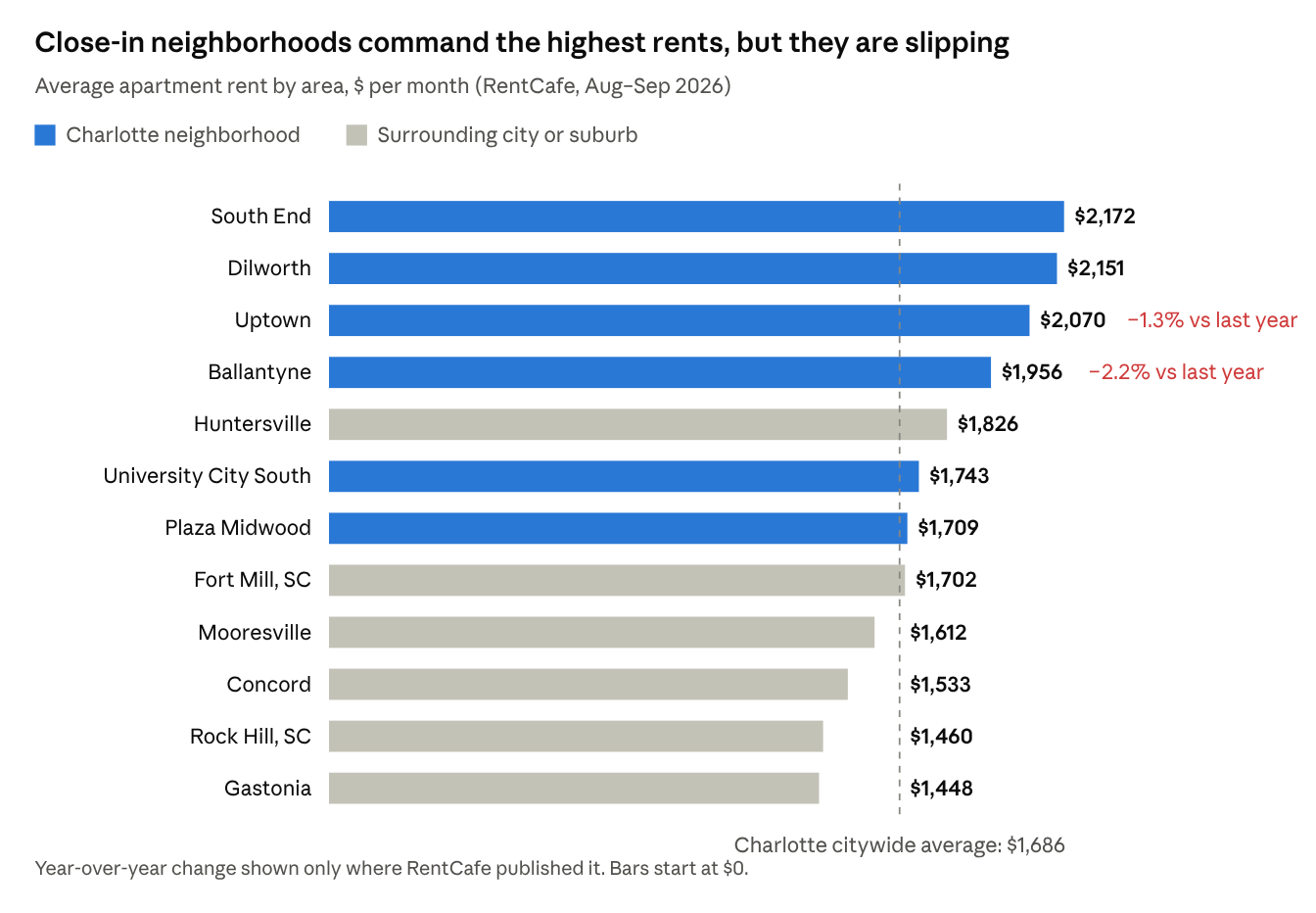
RentCafe average rent pages for Charlotte, Uptown and Ballantyne, updated Aug 31 to Sep 30, 2026
Close-in neighborhoods (South End, Uptown, Myers Park): RealPage named Uptown/South End and Myers Park among the hardest-hit submarkets, with 10 of Charlotte's 15 submarkets cutting rents earlier in 2026. Owners here should expect the heaviest concession competition.
• North and south suburbs (Huntersville, Fort Mill, Mooresville): Huntersville and Fort Mill rent above the city average, and these towns see far less new apartment supply, which makes them steadier for single-family owners.
• Value markets (Concord, Gastonia, Rock Hill): Rents of $1,448 to $1,533 draw renters priced out of the core, keeping demand solid for well-kept homes. Neighborhood-level year-over-year data is thin; we will add more areas as providers publish them.
What this means for Charlotte property owners
In a flat market, the owners who win are the ones who price precisely and keep good residents in
place.
• Price to the street, not to last year. A home listed $100 over the market can sit for weeks. A short vacancy almost always costs more than a slightly lower rent.
• Plan for concessions. With most apartments offering a free month or more, a small targeted incentive can win the renter you want without cutting your base rent
• Renewals are worth more than ever. Turnover means cleaning, repairs, marketing and
empty months. A modest renewal increase that keeps a good resident usually beats a
bigger increase that loses them.
• Know your area. Close-in neighborhoods such as South End and Uptown compete
directly with new luxury buildings. Suburbs with little new construction tend to hold
rents better.
• Watch 2027. As fewer new apartments open, concessions should fade and rent growth should return. Owners who keep units leased and maintained now will be best placed for that turn.
Listing not moving? Let's look at it together
F.I.R.M. manages rental homes across the Charlotte area. Send us your address or listing link. We will compare it with current Charlotte rents and concessions nearby, show you what is holding it back, and lay out how we would get it leased. Contact F.I.R.M.
Guides for Charlotte owners
• Why Is My Charlotte Rental Not Renting?
• What a Vacant Rental Really Costs
• Should You Offer a Move-In Special?
• How to Price a Rental Home in Charlotte
Sources
• Zillow Research, Observed Rent Index (ZORI) monthly rent reports, February, April, June, July and September 2026: February, April, June, July, press release, April 21, 2026
• Apartment List, Charlotte, NC Rent Report, September 2026
• RealPage Analytics, 3Q 2026 U.S. Apartment Demand Update
• RentCafe (Yardi), Average Rent in Charlotte, NC by Neighborhood, Uptown and
Ballantyne, August–September 2026
• Matthews Real Estate Investment Services, Charlotte Multifamily Market Report Q1 2026
• Northmarq, Charlotte Multifamily Market, Q1 2026
• TD Economics, U.S. Multifamily CRE: Still Soft Fundamentals
• Rental Beast, Charlotte Rental Market Report Q2 2026